A Simple Guide for Business Owners
For the last 20 years, the goal of a business website was simple: look good for humans and rank well for Google. You built a “digital storefront,” added some keywords, and waited for customers to click.
But in 2026, the rules are changing. We are moving from a world where people search and click to a world where people ask and get answers.
Tools like ChatGPT, Claude, and Google’s AI Overviews don’t just give a list of links; they give a direct answer. If someone asks, “Who is the best affordable plumber in Chicago?”, the AI recommends a specific business based on the data it can read.
Here is the scary part: To an AI, your beautiful, expensive website might look like a blank page.
If your site isn’t “machine-readable,” these new AI tools will ignore you. The good news? You don’t need a team of engineers to fix it. Here is a simple, non-technical guide to preparing your small business website for the AI era.
1. The “Nametag” Rule: Use Structured Data (Schema)
Imagine attending a crowded networking event without a nametag. You might be the best expert in the room, but nobody knows who you are.
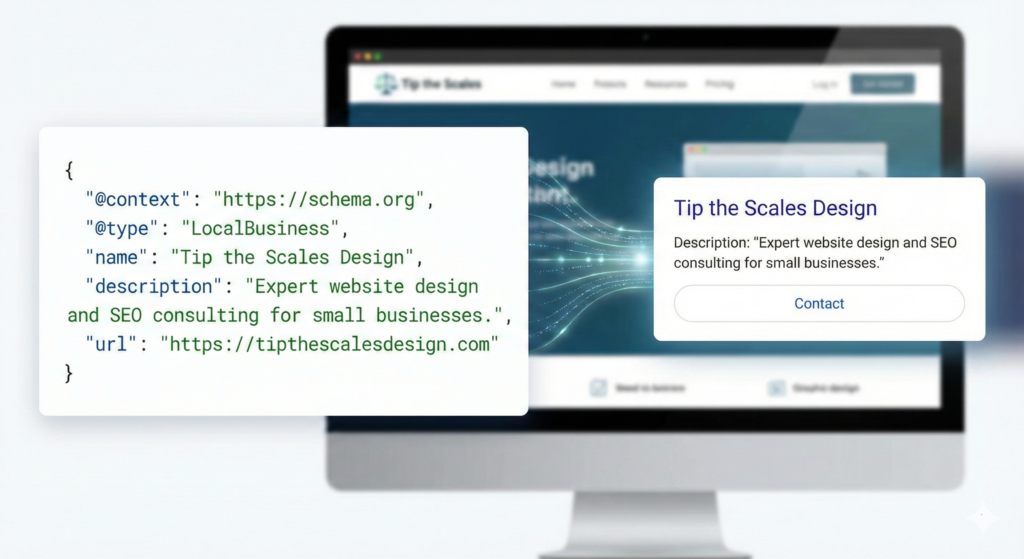
Structured Data (specifically something called JSON-LD) is a digital nametag for your website. It is invisible code that tells robots exactly what you are. Without it, an AI has to guess if “Apple” means the fruit or the tech company. With it, you explicitly tell the AI:
- “We are a Local Business.”
- “We are located at [Address].”
- “We sell [Product] for [Price].”
Action Item: Ask your web designer if your site has “LocalBusiness Schema” installed. It’s the single best way to make sure AI knows you exist.
2. Don’t Hide Your Text in Images
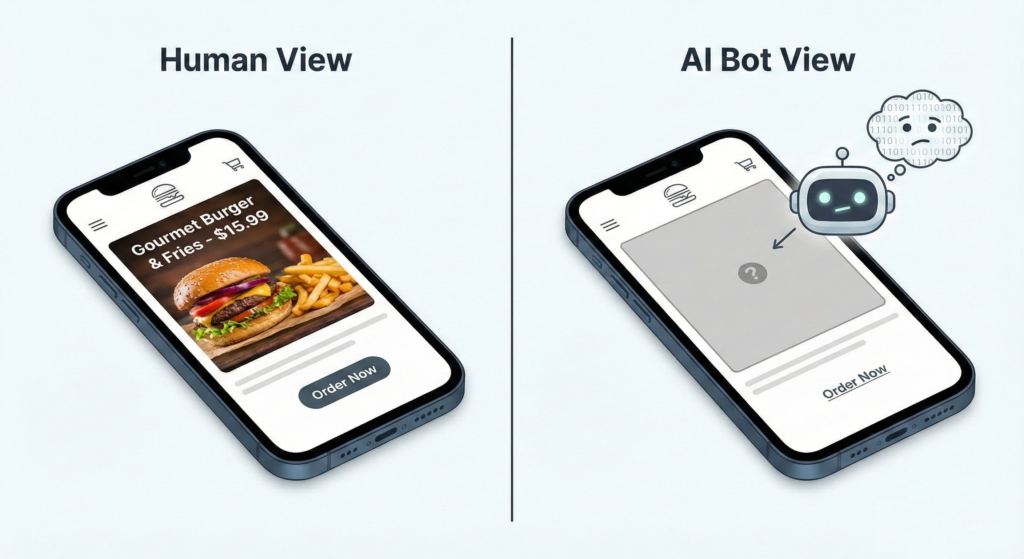
We see this mistake often: a restaurant posts its menu as a JPEG image, or a consultant puts their list of services inside a graphic on the homepage.
To a human, this looks great. To a standard AI bot, it looks like a blank box. Most AI crawlers read text code; they don’t “watch” your website like a video. If your pricing, hours, or services are trapped inside an image, the AI effectively thinks that information doesn’t exist.
Action Item: Ensure all important text—especially what you do and how much it costs—is written as real text on the page, not embedded in a picture.
3. Pass the “Right-Click” Test
Many modern websites use fancy technology (JavaScript) to load content. It looks smooth, but sometimes the robots arrive before the content loads.
You can test this yourself right now:
- Go to your website.
- Right-click on the background (not on an image).
- Select “View Page Source” (not “Inspect”).
- Look at the code. Can you see your main paragraphs and services written in plain English?
If you mostly see code gibberish and none of your actual content, your site might be invisible to AI bots that scan quickly. You need your web developer to ensure your site uses “Server-Side Rendering” or simple HTML text.
4. Create an “FAQ” Section (The Cheat Sheet)
AI tools are basically question-answering machines. The easiest way to get them to quote you is to feed them questions and answers directly.
On your service pages, add a simple Frequently Asked Questions section.
- Question: “How much does a kitchen remodel cost?”
- Answer: “A typical kitchen remodel costs between $20,000 and $50,000…”
This creates a perfect match. When a user asks an AI that exact question, the AI sees your site has a ready-made answer and is more likely to cite you as the source.
5. The New Standard: llms.txt
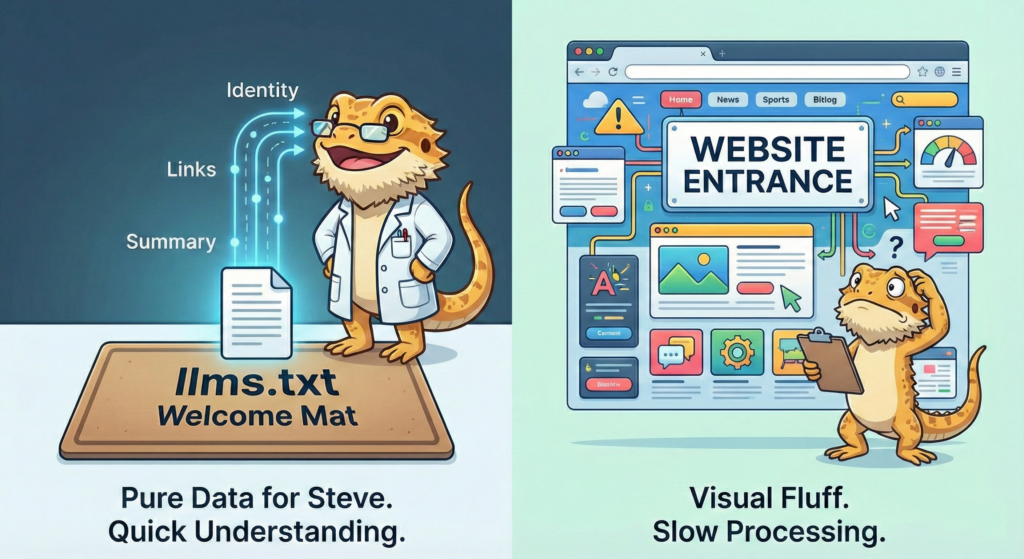
There is a brand new standard emerging called llms.txt. Think of this as a “Welcome Mat” specifically for AI robots.
It is a simple text file we place on your website that says, “Hey Robots, here is exactly who we are, here are our most important links, and here is a summary of what we do.” It skips all the design fluff and gives the AI pure data. It’s a small file that can make a huge difference in how quickly AI understands your business.
6. Your “About” Page is Your Resume
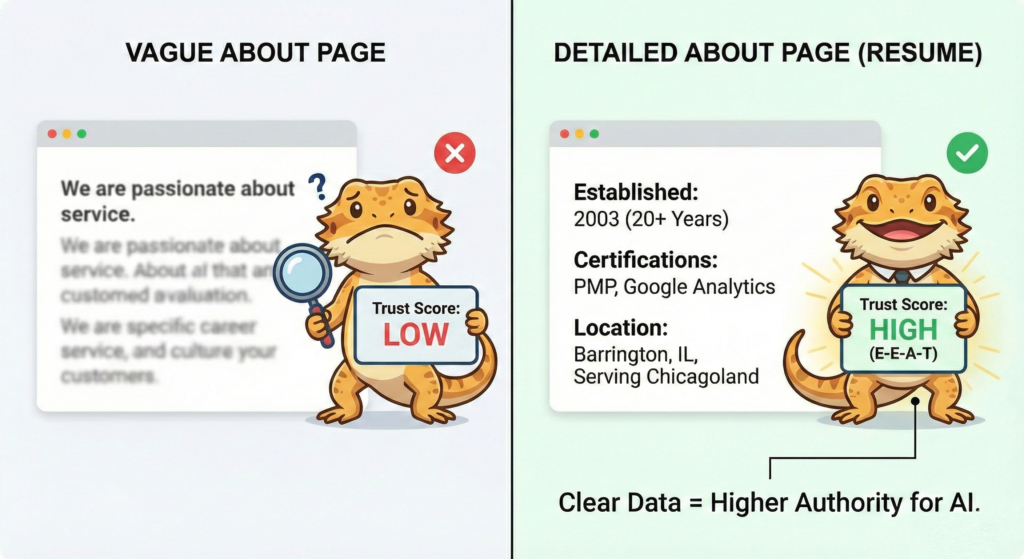
Finally, stop writing vague “About Us” pages. AI relies on Authority. It wants to know why it should trust you.
Your About page should clearly state:
- How many years you have been in business.
- Your certifications and licenses.
- Your physical location and areas served.
If this information is clear and consistent, the AI assigns your business a higher “Trust Score” (E-E-A-T), making it more likely to recommend you over a competitor.
We Can Help You “Tip the Scales”
The shift to AI search feels technical, but it’s really just about clarity. It’s about ensuring your digital home is as welcoming to robot assistants as it is to human customers.
At Tip The Scales Design, we have decades of shared experience navigating these digital shifts. We specialize in helping small businesses verify their “AI Readiness” without the jargon.
If you are unsure if your website is passing the “Right-Click Test” or if you need help setting up your digital nametag, please reach out. We are happy to help you prepare for the future.
Pinnacle Sports Inc visits Tip the Scales Design!
Jeff and the team at Pinnacle Sports Inc came to us when they needed to modernize and optimize their website to increase its reach locally and abroad. Make sure your website is being found by the people you want to do business with, and it’s easy to use, whether it’s a person or an AI search bot!