At Tip the Scales Design, our mission is to bring your brand’s vision to life through strategic branding, stunning visuals, and engaging digital experiences. As an agency specializing in crafting world-class digital products for the modern era, we know that a website in 2026 must be more than just visually appealing; it must focus on accessibility as well. It serves as your storefront, your communication hub, and a critical gateway that must be accessible to everyone.
The digital landscape has reached a turning point. Rapid advancements in Artificial Intelligence (AI) and tightening global legislation have merged search engine optimization (SEO) and digital accessibility into a single, cohesive strategy. Here is our comprehensive guide to navigating compliance with the Web Content Accessibility Guidelines (WCAG) and the European Accessibility Act (EAA), while simultaneously boosting your technical SEO and preparing for the future.
Key Aspects of the 2025-2026 Accessibility Updates
1. The Regulatory Reality: The EAA and ADA
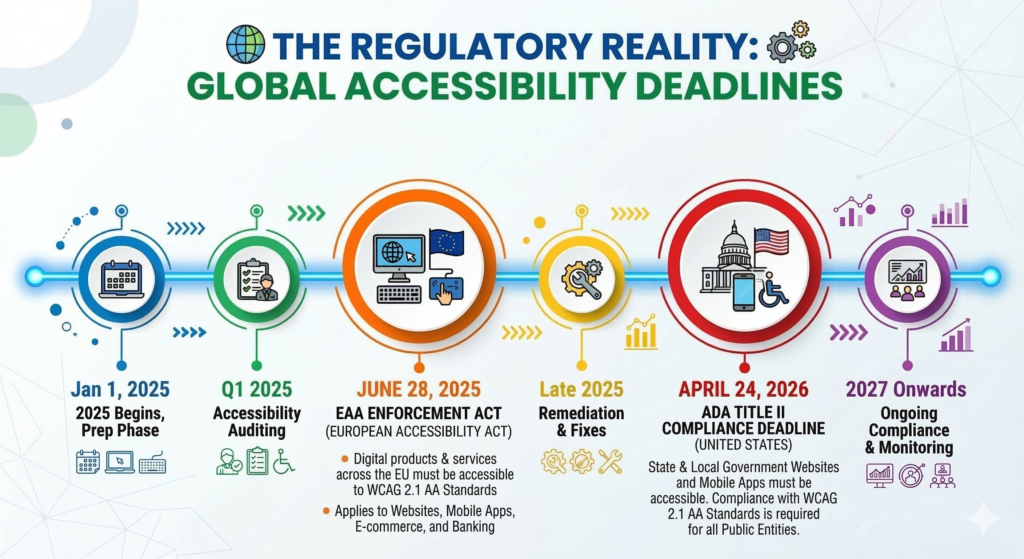
The European Accessibility Act (EAA) went into active enforcement on June 28, 2025. This sweeping directive applies to any organization selling digital products or services to consumers within the EU, regardless of where the business is headquartered. The financial penalties for non-compliance are severe; for instance, fines can reach up to €250,000 in France and up to 10,000,000 SEK (approximately €900,000) in Sweden.
Simultaneously, the United States is seeing aggressive legal momentum. With ADA Title II updates enforcing stricter technical standards by April 2026, private sector businesses—especially e-commerce, home services, and medical practices—are facing an unprecedented surge in digital accessibility lawsuits.
2. The Ranking Impact: Accessibility as a Growth Engine
Optimizing your website for inclusivity is no longer just about legal compliance; it is a proven driver of organic growth. Search engines and AI algorithms reward websites built on clean, highly structured code—the exact same foundation required by screen readers and assistive technologies.
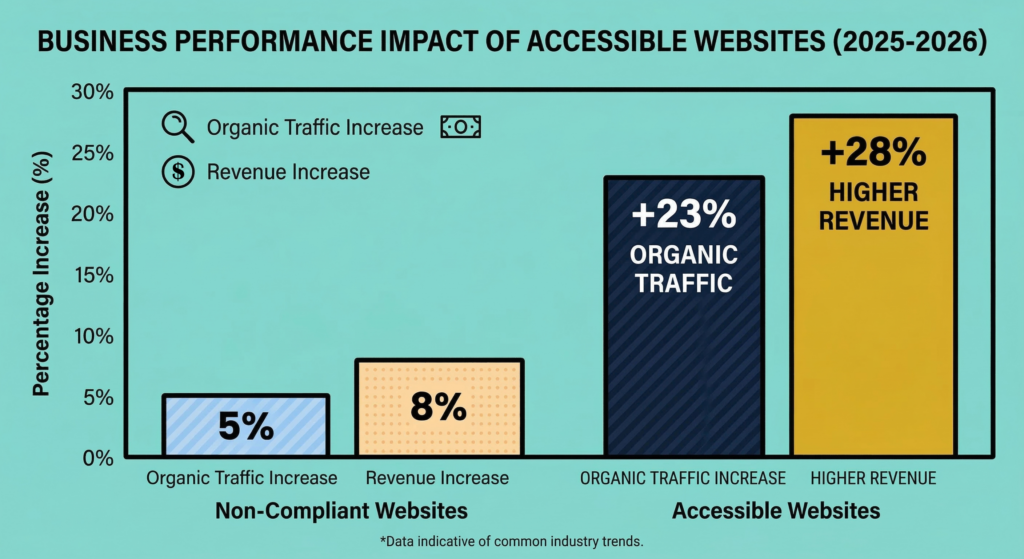
A recent study analyzing 10,000 websites revealed that compliant platforms experience a 23% increase in sustained organic traffic, rank for 27% more keywords, and boast a 19% stronger domain authority score. For e-commerce brands, the stakes are even higher. Inaccessible sites suffer a staggering 69% cart abandonment rate among users with disabilities, whereas companies embracing inclusive design report up to 28% higher revenue. Ultimately, Forrester Research notes that investments in accessibility can yield a $100 return for every $1 invested, making it one of the highest ROI initiatives you can undertake.
3. Technical SEO and AI Search Engines
As users transition to AI Overviews, Google’s Gemini, and other Generative AI search platforms, technical SEO must evolve into Generative Engine Optimization (GEO). AI crawlers require extreme topic clarity and explicit structured data to generate answers.
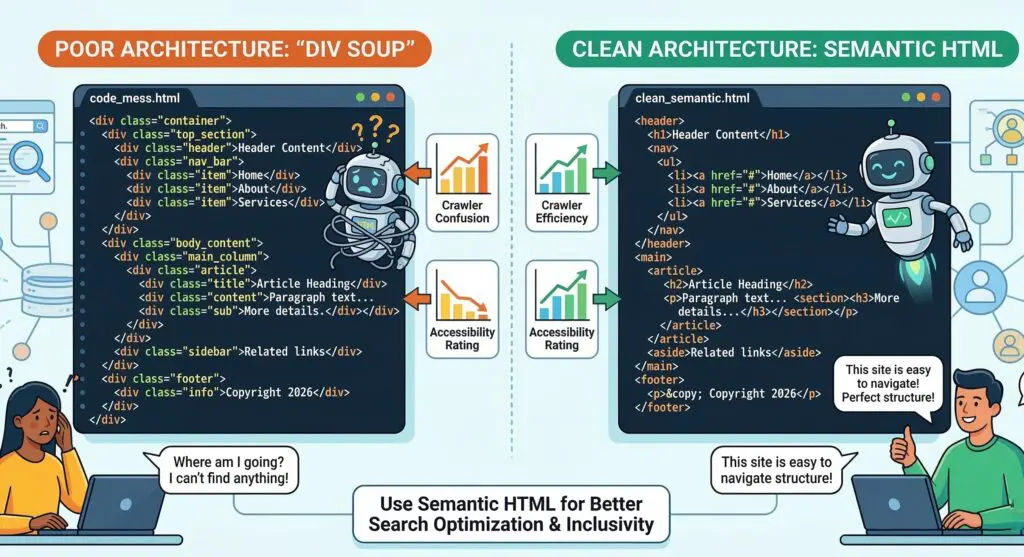
The most critical intersection of technical SEO and accessibility is Semantic HTML. In 2026, developers must avoid “Div Soup”—the practice of relying on generic <div> tags for layout. While it may look fine visually, it presents a chaotic mess to algorithmic bots and screen readers. Utilizing proper semantic tags like <header>, <main>, and <nav> instantly communicates your site’s architectural hierarchy, improving algorithmic parsing and allowing visually impaired users to navigate seamlessly.
4. Android 16 & AI Enhancements
Accessibility compliance extends beyond the browser. The release of Android 16 introduces powerful new APIs designed to enhance User Interface (UI) semantics, guaranteeing better consistency for users relying on native services like Google’s TalkBack screen reader. Android 16 also introduces profound hardware integrations, such as allowing a smartphone to function as a direct microphone input for LE Audio hearing aids during phone calls in noisy environments. If your business utilizes a native mobile app, it must seamlessly interface with these OS-level advancements.

Furthermore, AI-powered accessibility auditing tools have become indispensable. These tools can scan thousands of complex pages in minutes, allowing developers to catch code errors before they go live. However, AI has limitations. Automated tools currently only detect about 30% of total WCAG violations because guidelines are highly nuanced and require contextual human interpretation. AI is a powerful assistant, but it cannot replace human expertise.
5. Future Focus: WCAG 3.0 and Immersive Environments
While organizations must currently maintain strict WCAG 2.2 AA compliance, the World Wide Web Consortium (W3C) is actively developing WCAG 3.0. This upcoming standard completely restructures how accessibility is measured, moving away from binary “pass/fail” checklists to a multi-layered, functional-needs model.
Crucially, WCAG 3.0 provides specific guidelines for the future of spatial computing, including Augmented Reality (AR) and Virtual Reality (VR). Forthcoming guidelines will mandate features like centered immersive captions, alternatives for spatial audio, and ensuring that critical functions do not rely solely on specific body movements or eye-tracking.
Key Recommendations for Compliance Going Forward
To protect your business and maximize your online visibility, we recommend integrating accessibility into every phase of your digital strategy. At Tip the Scales Design, we utilize a proven four-step process—Discovery, Design, Quality, and Launch—to ensure your website is both beautiful and bulletproof.
- Conduct a Hybrid Audit (Quality Phase): Do not rely solely on automated scanners. Combine automated AI testing to catch programmatic errors with rigorous manual code reviews and real-world Assistive Technology (AT) testing.
- Prioritize High-Impact Technical SEO Fixes: Rebuild your site architecture using strict Semantic HTML. Eliminate layout shifts (Core Web Vitals) to prevent disorienting screen jumps, and deploy comprehensive ARIA attributes and Schema.org markup to feed clean data to AI crawlers.
- Establish Continuous Monitoring: A compliant site can become non-compliant with a single plugin update or holiday promotion. Implement continuous monitoring protocols to catch traffic drops, broken links, and accessibility barriers in real-time.
- Publish an Accessibility Statement: If you serve European customers, you must publish a detailed accessibility statement outlining your conformance methodologies to meet the EAA requirements.
Ready to Tip the Scales in Your Favor?
Ensuring your website meets global compliance standards while dominating AI search results requires strategic expertise. Whether you are a brave startup or an established legacy brand, our team is here to break down complex technical solutions into clear, value-driven results.
Let’s turn your digital goals into reality. Reach out to Tip the Scales Design today to schedule your comprehensive digital review.
Contact us at 815-615-9299 or info@tipthescalesdesign.com, or visit our office at 27990 N Converse Rd., Island Lake, IL 60042.